

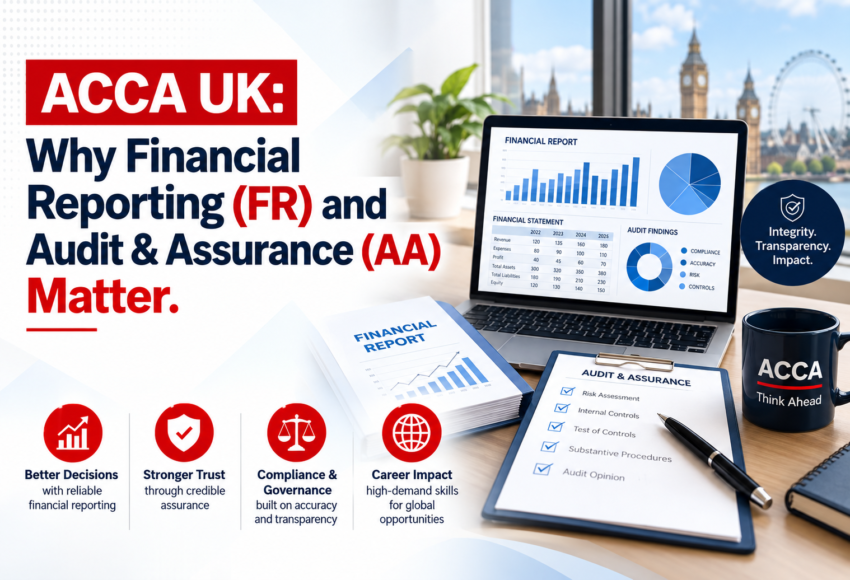
ACCA UK: Why Financial Reporting (FR) and Audit & Assurance (AA) Matter
(Two Applied Skills papers that connect financial statements, professional judgement and assurance)
The ACCA qualification is designed to develop professionals who can understand business, interpret financial information and apply sound judgement. Within the Applied Skills level, Financial Reporting (FR) and Audit & Assurance (AA) are especially important because they develop two closely connected perspectives: how financial statements are prepared and interpreted, and how an independent auditor evaluates whether those statements can be relied upon.
FR: Building the Language of Financial Reporting
ACCA FR develops knowledge and skills in applying accounting standards and the conceptual framework to the preparation of financial statements, including group financial statements, and in analysing and interpreting financial performance and position. For students pursuing ACCA India, FR is much more than an examination paper: it builds the technical accounting base needed in reporting, finance, controllership and assurance roles.
A strong understanding of ACCA FR helps students move from recording transactions to understanding the logic behind recognition, measurement, presentation and disclosure. Students learn to connect accounting standards with real business events and to read financial statements with a professional eye. This becomes increasingly valuable as they progress to Strategic Professional studies, particularly Strategic Business Reporting (SBR).
AA: Learning to Think Like an Auditor
ACCA AA introduces the process of assurance engagement within a professional and regulatory framework. It covers areas such as audit planning, risk assessment, internal controls, audit evidence, completion and reporting, while reinforcing ethics, professional scepticism and professional judgement.
| The paper is practical in nature. Students are expected not merely to remember audit terminology, but to apply concepts to business scenarios: identify audit risks, recommend controls, design relevant audit procedures and understand the implications of audit findings. This makes ACCA AA particularly useful for students interested in external audit, internal audit, risk, compliance, governance and assurance careers. FR explains how financial statements are built. AA develops the discipline to question, test and conclude on those financial statements. |
Why FR and AA Work So Well Together
The relationship between these two papers is one of their greatest strengths. An auditor cannot effectively assess financial statements without understanding the underlying treatment of accounting. Likewise, a finance professional benefits from understanding how auditors challenge estimates, test balances, evaluate controls and assess whether reporting is supported by sufficient appropriate evidence.
For example, FR may teach the accounting principles relating to inventory, revenue, provisions, property, plant and equipment or receivables. AA then asks the student to consider the risks of material misstatement in those areas and the procedures an auditor should perform. Studying the papers with this connection in mind helps students develop integrated professional thinking rather than treating accounting and audit as separate subjects.
Their Place in the Overall ACCA Journey
FR and AA sit within ACCA’s Applied Skills level, alongside Corporate and Business Law, Performance Management, Taxation and Financial Management. The Applied Skills stage is intended to build broad, practical finance capabilities before students’ progress to the Strategic Professional level. In this progression, FR provides an important foundation for advanced reporting, while AA develops assurance skills that can support later study in Advanced Audit and Assurance (AAA) for students who choose that option.
Together, the papers strengthen analytical ability, written communication and professional judgement. These are not only examination skills; they are capabilities used by accountants when explaining financial results, assessing risk, documenting conclusions and communicating with management, auditors and other stakeholders.
Career Relevance for ACCA Students in India
For students considering ACCA India as a route to a global accounting career, FR and AA offer highly transferable knowledge. Financial reporting skills are relevant across accounting, financial reporting, consolidation, shared services and finance operations. Audit and assurance knowledge supports opportunities in audit firms, internal audit teams, risk functions, governance and compliance roles. The combination can be particularly useful in multinational companies and global capability centers, where finance professionals work with international reporting and control environments.
Choosing the Right ACCA Coaching Support
Students searching for ACCA coaching in Chennai or ACCA coaching in Nungambakkam should look beyond classroom hours alone. Effective coaching for ACCA FR and ACCA AA should combine concept clarity, exam-focused application, question practice, regular revision, mock examinations and feedback on written answers.
When comparing Top ACCA institutes in Chennai or Best ACCA Institutes in Chennai, students should evaluate faculty experience, structured study plans, doubt-clearing support, access to practice resources and the institute’s ability to connect technical concepts with practical examples. This is especially important in AA, where scenario-based application matters, and in FR, where students must combine calculations with explanation and interpretation.
Understanding ACCA Course Fees in Chennai
ACCA course fees in Chennai can vary depending on the number of papers taken, exemptions, classroom or online mode, study materials, revision support and mock-exam packages. Students should also distinguish coaching fees charged by an institute from ACCA’s own registration, annual subscription, exemption and examination fees. A useful comparison therefore focuses on total learning value and support, not simply the lowest quoted tuition fee.
A Practical Study Approach for FR and AA
• Build the concepts first. Understand the accounting or audit principle before memorising an answer format.
• Practice application. Work through scenario-based questions and learn to connect each point directly to the facts given.
• Use FR knowledge in AA. When identifying audit risks and procedures, revisit the relevant financial reporting treatment.
• Develop exam discipline. Practice computer-based questions, time management, clear workings and concise professional writing.
• Revise continuously. Short, regular revision cycles are more effective than leaving technical standards and audit procedures until the final weeks.
Conclusion: Two Papers, One Professional Mindset
ACCA FR and ACCA AA are central to developing the mindset of a well-rounded professional accountant. FR teaches students to prepare, understand and interpret financial information; AA teaches them to evaluate that information with independence, evidence and professional skepticism. For an ACCA student, mastering both papers creates a strong bridge from technical accounting knowledge to real-world professional judgement.
For learners exploring ACCA coaching in Chennai, particularly ACCA coaching in Nungambakkam, the right learning environment can make these demanding papers more structured and approachable. With strong fundamentals, disciplined question practice and expert academic guidance, FR and AA can become important steppingstones toward ACCA membership and a rewarding career in accounting, reporting, audit and assurance.


Leave a Comment